
Materials + Process + Repairs
Mixed Metals
What kind of metal do you use?
I use sterling silver, brass, gold fill and keum-boo gold.
What is sterling silver?
Sterling silver (as opposed to fine silver) is an alloy (mix) of 92.5% silver and 7.5% copper. Fine silver does not contain any copper but is very soft, adding the copper to the silver creates a harder, more durable metal for jewelry.
What is brass?
Brass is a yellow metal that is an economical alternative for gold but does tend to tarnish over time requiring some maintenance. There are varying alloys of brass available but the two that I tend to use are jewelers brass sheet which contains 85% copper and 15% zinc and Alloy 260 for brass tubing which is 68.5-71.5% copper, 28.5-31.5% zinc, up to .05% iron and up to .07% lead.
What is gold fill?
Gold fill is another great alternative to solid gold. Gold fill is a thick layer of 14K gold pressure bonded to a base metal (generally brass). Unlike gold plated, gold fill will not wear off over time.
What is Keum Boo?
Keum Boo is an ancient Korean technique of applying gold foil to silver. I use sterling silver as my base layer and heat bond gold foil to the silver. The process can be time consuming but the stunning result of the mixed metals is so worth it! I use 23.5 karat gold (98% gold, 1.5% silver and .5% copper).

Keum-Boo jewelry, oxidized (blackened) silver with gold.

Gold Fill Hoops
What is the black metal ?
The black metal in my work is oxidized sterling silver. I apply a patina to the silver and then burnish it to create a beautiful black finish. In some pieces the patina is applied and then rubbed back to highlight patterns and texture. In other pieces the patina covers the entire piece for a rich black finish. Oxidized jewelry seldom needs to be polished. You can clean your jewelry in mild soapy water as needed. Depending on the wear, the oxidized patina can wear off over time. I charge a small fee for refinishing jewelry, send me an email and we can discuss options.

Who makes your jewelry?
All of my jewelry is handmade by me in my studio in Kingston, WA..
I have a metal allergy, can I wear your jewelry?
Yes. Maybe. No. The answer is complex and can highly depend on the severity and type of allergy.
All of the metal that I use is nickel free. Most of the metal that I use has some amount of copper content.
Here is the break down of the various metals I use and what is in them:
925 Sterling Silver: 92.5% silver, 7.5% copper
14/20 Gold Filled: gold, silver, copper, zinc
Brass sheet (jewelers brass): 85% copper and 15% zinc
Brass tubing: 68.5-71.5% copper, 28.5-31.5% zinc, up to .05% iron and up to .07% lead
Keum Boo Gold: 23.5 karat gold (98% gold, 1.5% silver and .5% copper)
Is your metal recycled?
I buy almost all of my metal from Rio Grande Jewelry Supply. I buy from Rio Grande because they are a trusted source in a large and complex metals industry. Rio Grande uses as much recycled metal as possible and whenever possible, specifically in their silver. However it cannot be guaranteed that the silver I buy is 100% recycled but all silver has a large portion of recycled content. You can find out more about Rio Grande and their commitment to ethically sourced materials here: Rio Grande
In the roll-printing process, textures and patterns are achieved by imprinting a design onto the metal with the pressure of my rolling mill. I achieve this in several ways. I create roll printing plates by hand drawing and then etching that drawing onto a thick piece of brass. The etched design can then be used to imprint other metals for jewelry. More recently, I have begun to digitally design patterns that are then laser engraved on thick paper. I can then use the engraved paper with my rolling mill to imprint my designs onto metal. Pretty cool, huh?!
What does roll-printed mean? Is your jewelry stamped?
No it’s not stamped! It’s roll printed!
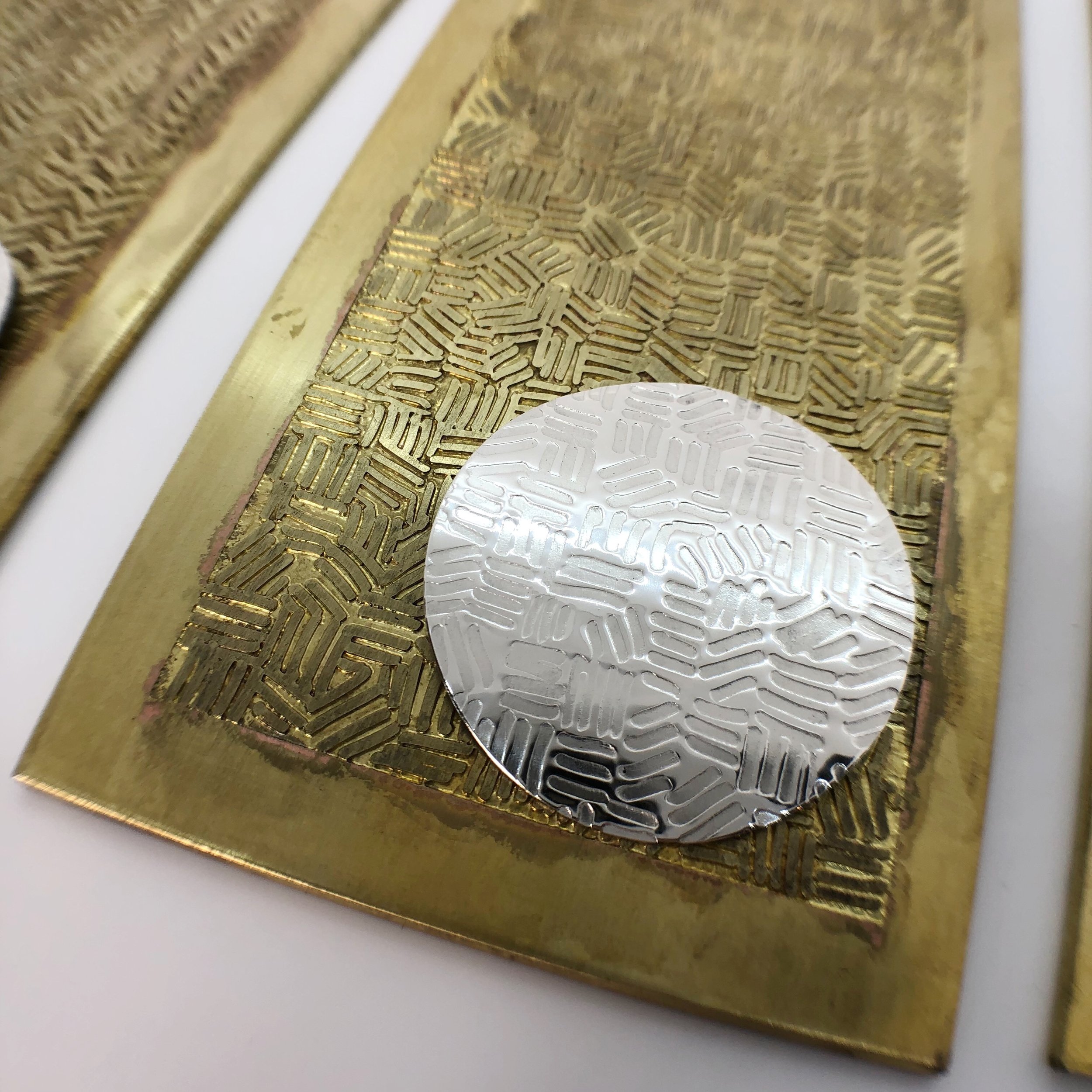
Above is an etched brass roll-printing plate with a roll printed silver circle.
Do you do repairs?
I offer repairs for jewelry that I have made, for a small fee. Please reach out with a photo of the piece, and we can discuss the repair and next steps.
The most common repair I see is a broken chain. Please keep in mind that chains are designed to break if they become caught or pulled, helping to prevent injury to the wearer. A common example is a necklace being accidentally yanked by a small child.
Because each repair is different, I will need to evaluate the break to determine whether it can be repaired or if the piece will need to be replaced.
Many of the pendants I create are integrated directly into the chain. Depending on where the chain breaks, it may not be possible to repair the piece, and replacement may be necessary.
Repairs requested more than six months after the date of purchase will incur a fee for time and materials.
I lost an earring, can you replace it?
All of the pieces I create are one of a kind. Even when I make a small collection of 4–6 similar pieces, each one will have its own unique variations.
If you lose an earring and would like me to recreate a matching replacement, you will need to send the remaining earring back to me so I can use it as a reference while making the new one.
Creating a single replacement earring does not take half the time or materials of making a pair, so the cost to recreate a matching earring is 65% of the original price of the pair.
Please also be aware that in some cases, I may not be able to recreate an exact match. My patterns and textures change over time, and the roll-printing plates I use eventually wear out and need to be retired. If the original pattern or texture is no longer available, I may not be able to reproduce the earring to match.